Organic vs Paid Social Media: What’s the Difference and Why Your Language School Needs Both
Organic vs Paid Social Media: What’s the Difference and Why Your Language School Needs Both
 Gina Rodriguez
When I review a language school’s social media activity, I often find one of the following situations:
Some language schools invest a lot of time creating organic posts but struggle to reach new prospective students.Others invest in Meta advertising to generate enquiries, but haven’t given enough thought to what happens when someone clicks on an advert, visits their page or submits a form.
And sometimes, schools are doing both organic and paid social media, but the two activities aren’t really working together.
Working with with language schools on their marketing strategies, I’ve seen how much difference it can make when organic and paid social media are connected to a SMART business goal.

About me: Hi, I’m Gina Rodriguez. I’m a qualified Digital Marketing Specialist and I work as a Social Media Strategist & Marketing Consultant for the language education sector . I have 25+ years experience in the English Language Teaching (ELT) industry. I have covered various roles from EFL teacher, teacher trainer to Sales & Marketing Consultant in educational publishing.
What I do: I help language schools build an engaging social media presence through training, consultancy and tailored strategies.
👉Sign up to my newsletter for Social Media Post Ideas to keep you inspired and consistent.
In this article, I’ll explain the difference between organic and paid social media, when each makes sense and how to combine them. I’ll also share examples from my consultancy work to show what this looks like in practice.
Interested? Read on!
What is Organic Social Media?
Organic social media refers to all the content you post on social platforms without paying the platform to get them seen. This is the “normal” way of using social media: you create a post on your school’s Facebook or Instagram page, hit publish, and hope your followers (and maybe their friends) see it and engage. The truth is that only those who follow you (and a small percentage of others the algorithm decides might like it) will typically see your content.
It’s called “organic” because growth happens naturally, thanks to your followers sharing or the platform’s algorithm showing your content to people who might find it interesting. BTWm, take this as a hint for creating content 😉
Benefits of Organic Social Media
- It’s cost-effective: Posting organically doesn’t cost money, which is great if you have a tight marketing budget. You can maintain a social media presence and keep connecting with your audience without having to pay to post but it’s not totally free as your time has a value. Every post, comment or story you share is “free” exposure for your school.
- Builds trust and community: Organic content lets you showcase your school’s personality and engage authentically with students and prospects because people tend to trust content that doesn’t feel like an advertisement. In fact, consumers overwhelmingly trust recommendations, word-of-mouth and user-generated content more than traditional ads. By sharing genuine stories (like student testimonials, teacher introductions, video clips of studetns in your lesson activities,etc), you foster a sense of community. Over time, this earns you followers’ trust, which is invaluable for a service as human as language education is.
- Long-term relationship building: Because organic social is about conversation and engagement, it helps you build relationships over time. Someone who follows your school’s page might not enroll in a class immediately, but through consistent organic posts they’ll get to know, like and trust your brand (provided you post content to build the KLT factor ) . When they’re ready to learn a language (or refer a friend), your school will be top of mind thanks to the rapport you built organically.
Challenges of Organic Social Media
- Limited reach due to algorithms: The biggest hurdle with organic social media is simply getting seen. Social networks like Facebook and Instagram don’t show your posts to all your followers. In fact, according to Social Insider, the average Facebook page post reaches only about 1–2% of its followers on average.
Instagram’s organic reach is a bit better, around 3.5% of followers but still a small slice. This means if you have 1,000 followers on your school’s page, maybe only 10 or 20 people will see a given post unless it’s exceptionally engaging or gets widely shared.
- Slow to grow: Building an audience organically takes time and consistency. You might post diligently for weeks to gain a handful of new followers. Especially if you’re starting from scratch, the initial growth can be painfully slow. There’s no guarantee your wonderful content will go viral or even hit a large portion of your follower list due to the algorithm’s gatekeeping. This can be discouraging for language school expecting quick results. By the way, organic social media needs time so it’s not the best choice if you’re looking to increase enrolments within a certain time frame.
- Unpredictable exposure: Since organic relies on the platform’s algorithm and user behaviour, it can be a bit of a roller-coaster. One week your post might get decent engagement, and the next week a similar post barely reaches anyone. Algorithm changes (which happen frequently) can further drop your organic reach without warning. Basically, you don’t have full control and you’re at the mercy of each platform’s rules and trends.
Despite these challenges, organic social media is the foundation of your online presence. It’s where loyal communities are formed. Next, let’s look at the other side of the coin: paid social media.
What is Paid Social Media?
Paid social media is any social media content that you pay to distribute to a wider or more targeted audience instead of posting and hoping the algorithm delivers your content (as it happens with organic social media).
In other words, you’re essentially buying placement for it. When you do paid social, you can reach non-followers so it goes beyond your follower base which is essential to put your language school in front of potential new students.
The other advantage is that you can target people by demographics, interests or location.
For example, one mistake I often see language schools make when they are advertising a new language course is that they do one organic post and count the likes thinking that is what matters. Of course, it doesn’t generate enquires let alone enrolments. Then they say that social media doesn’t work. The real problem is that they ignore the low reach of organic posts. In this case, you need more than one organic post and and also paid posts.
“Your primary focus should be investing in a creative organic strategy and community building especially if you’re on a tight budget. Paid should support, not replace that work.” Sprout Social
Why organic social media matters for language schools
- Precision targeting: Paid social lets you pinpoint exactly who you want to reach. You’re not relying on the platform’s algorithm to hopefully find interested people you get to set the parameters. Want to show an ad to 25–40 year olds in New York who are interested in studying Italian in Rome? This ability to choose who sees your content means your message can reach the right potential students at the right time.
- Fast extended reach: With paid META advertising, you can get your posts in front of far more people almost instantly, as long as you’re willing to pay. This is powerful for enrolment campaigns where speed and scale are crucial. Basically, paid is great for quick visibility, whereas organic is a slow route which will take no-where when you need to reach new students fast online.
- Engagement tools and formats: Paid posts often come with special features that organic posts don’t have. For example, you can include a call-to-action button (“Sign Up Now”, “Learn More”) on a Facebook/Instagram ad, use lead forms to collect sign-ups for an Open Day, or have swipe-up links in a sponsored Story regardless of your follower count. These conversion-friendly formats make it easier to drive actions beyond just likes or comments.
- Measurable and data-rich: Paid social campaigns come with robust analytics. You’ll see exactly how many people saw the ad, clicked it, what it cost per click, etc. You can track conversions like how many actually signed up to the demo lesson through the ad. This detailed data helps a language school measure how many inquiries or enrolments an ad generated which is a valuable insight when calculating your marketing ROI (return on investment) and planning future campaigns.
Organic vs Paid Overview of META’s Insights
Here are the insights from a language school’s page managed at GR School Marketing. Check the two pics below and compare the drop in social media reach and views after the ads campaign has finished.
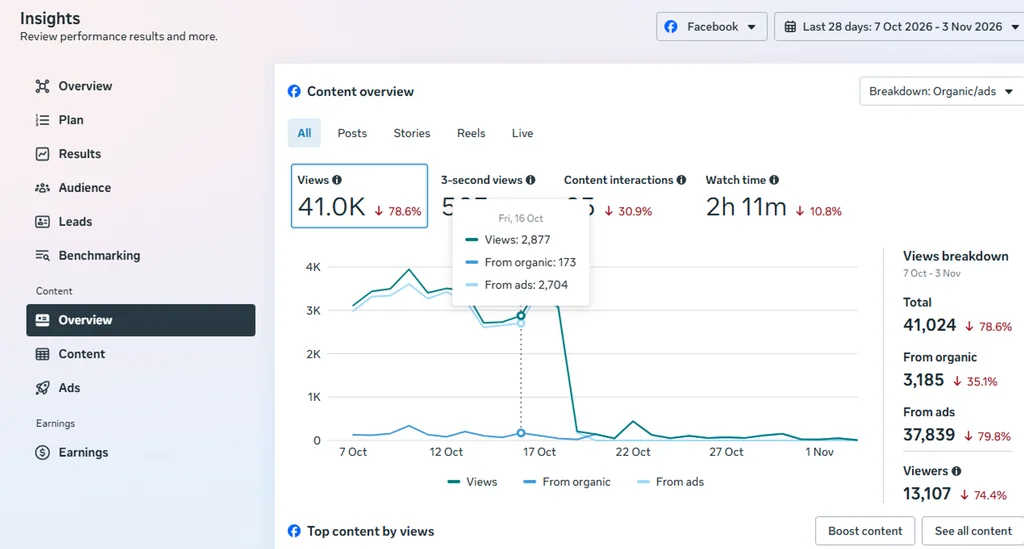
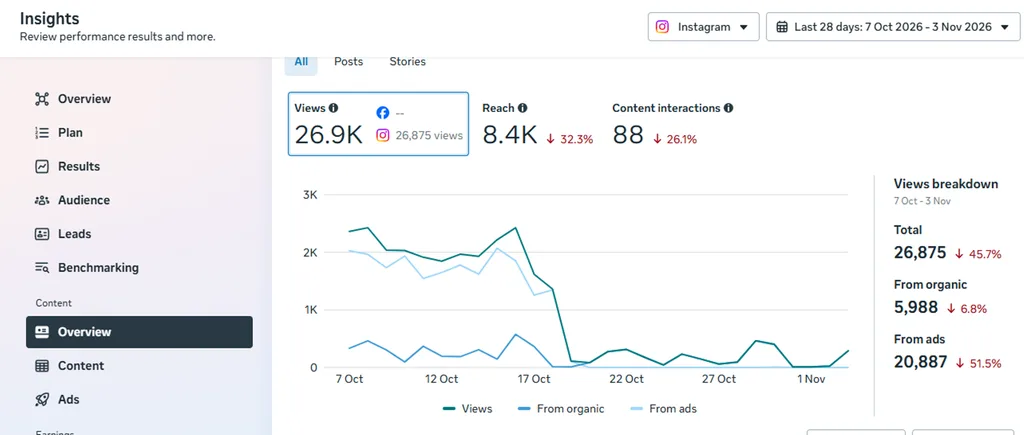
However, despite of these advantages, paid social media isn’t a magic wand and does have its own downsides to consider.
What to consider before investing in paid ads for your language school
Costs can add up: Every click, impression (view) or lead costs money, and those costs can rise quickly. If you’re not careful with the campaign set up in general you could burn through your marketing budget on ads without seeing a return. Social media ad spending has increased in the last years as more businesses are bidding for ad space but still worth the investment in my opinion.
Requires strategy and monitoring: You can’t just throw money at one post and hope for the best. Successful paid campaigns take planning (choosing the right objective, audience, message, creatives and format) and ongoing monitoring to optimize. If an ad isn’t performing, you may need to tweak the copy, adjust targeting, or change the budget. This adds a layer of complexity that pure organic posting doesn’t have.
Audience fatigue and ad skepticism: People are exposed to a lot of ads on social media, and not everyone who sees yours will welcome it. Some users scroll right past anything labeled “Sponsored.” If someone only ever sees ads from your brand and never any authentic posts, it can come off as overly salesy. Audiences don’t want to see only ads from you they also expect a genuine social presence. This is why paid social works best when complemented by organic content. This means that the organic posts build interest and trust, so that when an ad appears, users already recognize your brand and trust it more.
Learning curve: Each platform’s ad system (Facebook Ads Manager, etc.) can be a bit daunting if you’re new to it. Setting up targeting, deciding on the budgets, understanding reports require a skill that most language school owners understandably don’t have. For this reason, it’s advisable to get help from a marketing expert or you risk burning budget and wasting your time.
Why Paid and Organic Social Media Work Better Together
So as you have seen paid social media offers powerful tools to get your school in front of more potential students and parents, especially those who aren’t already following you. However, it does require an investment of money (and time in campaign management). For this reason, combining paid and organic is usually the ideal approach.
This is what I do for my clients’ social media strategy: I help them plan to use organic social for building relationships and brand awareness and paid social for driving specific actions and scaling up reach quickly. What you should do is use organic to nurture your audience over time and keep your school’s brand voice alive. On the other hand, use paid when you have a specific goal eg reach new people to grow your students numbers.
FROM MY CONSULTANCY WORK
How we aligned organic posts and paid advertising for adult courses of a language school.
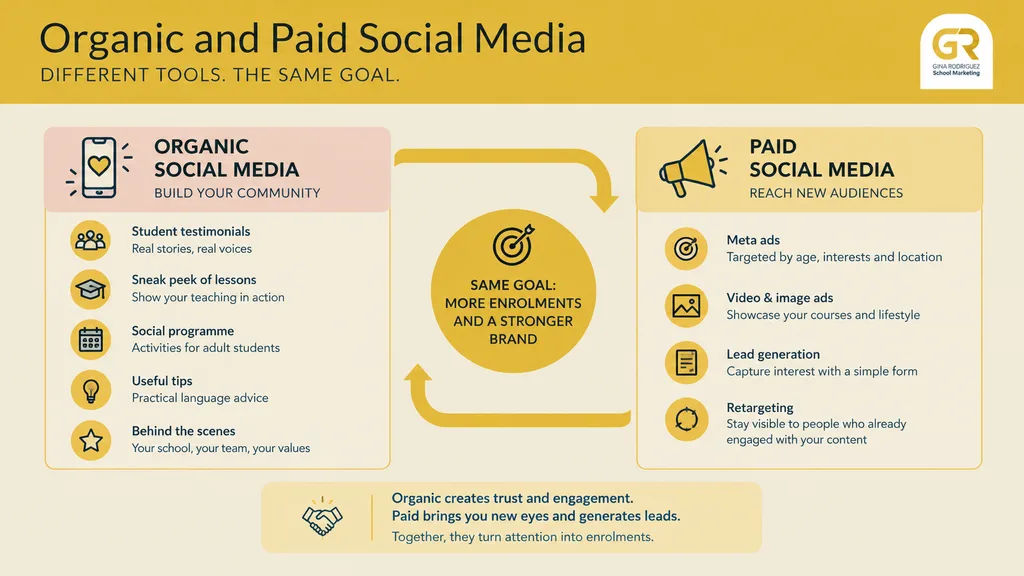
As you have seen, both organic and paid have unique strengths. Rather than choosing one over the other, the real magic happens when you use them together strategically. So, how do you decide when to use organic posts versus when to put budget into social media ads? Read on!
How to Combine Organic and Paid Social Media: 5 Tips for a Balanced Strategy
It’s not about choosing either organic or paid the real win is when you blend them effectively. Here are five important points to consider when you create a social media strategy that gets organic and paid working in tandem:
1. Start with organic to build your foundation
Especially if you’re a small or new language school, focus your initial energy on organic content and community building. Need inspiration? Start with these easy social media post ideas for language schools.
Post engaging content regularly, for example, share useful language hacks (nb hacks, not tips eg where to position your tongue for the sound /th/ ), showcase what makes your school different, the necessary steps to enrol for an exam, introduce the team, share students’ success stories and so on.
This consistent organic presence does a few things: it establishes your brand’s voice, it gives people a reason to follow and trust you, and it provides content for potential students to browse (people often check a language school’s social media page before deciding to enrol).
Please note what consistency means->

Your organic content is the bedrock of your social strategy and paid ads should support, not replace, the core content and connections you build organically. Plus, organic interactions (comments, DMs, replies) help you learn what your audience cares about. Listen to their feedback and questions as this insight is free market research.
When you’re ready to dip into paid social, you’ll be in a much better position to succeed.
2. Keep your branding cohesive across organic and paid
“Cohesive” simply means consistent and unified. Your social media presence should feel like one brand, whether someone comes across your content organically or through an ad. This means the tone of voice, the visual style, and the messaging in your posts and your ads should match up.
If your organic posts are friendly and full of emojis, but your ads are super formal and salesy, that’s a disconnection. Likewise, if your organic Instagram is all about vibrant classroom photos and your ad is an AI Slop post, it might feel off to the viewer.
Why is this important? Because inconsistency can damage trust and confuse your audience. Imagine a user sees a fun post from you in their feed, maybe a video of students celebrating exam success. Later, they see an ad from you that’s very generic or has a completely different tone (“Buy NOW! Best language course!”). The person might not even realize it’s the same language organization
On the other hand, if your paid ad feels like a natural extension of your organic content, same friendly teacher faces, same colours and logo, a similar conversational tone then people are more likely to trust it and engage. They’ll think, “Oh yeah, I know this language school, I’ve seen their posts, they seem helpful , their courses might be interesting.”

To do this, consider creating simple brand guidelines for your social media team. For more practical advice on making your school’s content recognisable, read my article on using photos and videos to market your language school
It can be as basic as deciding on a colour scheme, fonts, and a general voice (e.g. “encouraging and fun, not overly formal”). Then share these guidelines with anyone who makes content or ads for your school. And if you’re doing it all yourself, consciously check: does this new ad feel like it came from the same place as yesterday’s Instagram post? If not, tweak it so it does. Consistency across organic and paid will make your overall social presence much stronger and more memorable.
“If organic is planting seeds, paid is like fertilizer that helps certain seeds bloom faster and further“.
3. Treat social media as a full funnel (not just top-of-funnel fluff)
In marketing jargon, the “funnel” refers to the student journey from first hearing about you (top of funnel) to engaging and considering (middle) to eventually becoming a student (bottom). A common misconception is that social media is only for the top of this funnel, i.e just for brand awareness or a friendly presence. In reality, social media plays a role at every stage of the customer journey.
For your language school, that means you can use social media to:
- Attract new prospects who have never heard of you (through engaging posts or targeted ads to generate awareness).
- Nurture interested leads by providing value and interaction (answering questions in comments, sharing student success stories or language hacks that demonstrate your expertise because this builds consideration).
- Convert followers to students with timely offers or reminders (like an enrollment deadline countdown post or a retargeting ad saying “Join now, last 3 spots!” which drives the decision/ action).
Don’t treat social as just a billboard to get your name out (though it’s great for that, too). It’s also a place where people do research and make decisions.
“70%+ of consumers now use social media to help make purchase decisions in some industries, and likely a good number look up educational services there too“. Source Synup
Prospective students might scroll through your Instagram or Facebook to see reviews, comments, how you interact, in other words it’s like checking your reputation. They might even message you questions directly on Messenger or WhatsApp after seeing your page.
So, when planning content, think through the funnel: Some content will be purely for engagement/fun (to get people in the door). Other content can be informational, answering common questions or addressing concerns (helping those considering your school). And some can be direct calls-to-action (for those ready to act).
The combination moves people from just “liking” your posts to actually signing up for your courses. The big mistake I see a lot of language schools making is posting only top of the funnel content and wondering why they don’t get results (i.e enrolments and enquiries) from social media.
4. Tie your social media activity to enrolments
It’s important to remember your final goal: you’re on social media to help your language school thrive as a business. Likes and shares are nice, but they don’t pay your teachers’s salaries. You need to focus on metrics like inquiries, sign-ups, course bookings, and revenue.
That’s why you should track and analyze how both your organic and paid social media contribute to these outcomes. If you don’t measure results, you can’t tell what’s working or justify the time and money spent.
Start by defining a few key performance indicators (KPIs) that matter to you. For example: number of new student inquiries per month coming from social media, or enrollment conversions from social (perhaps using unique links or discount codes to track).
Platforms have built-in analytics; use them to see trends. Did launching that new ad campaign coincide with a spike in brochure downloads or contact form submissions? Are your organic posts driving traffic to your website’s registration page?
Sometimes the data is fragmented for example, Facebook shows you one thing, Instagram another, and you have Google Analytics for your website, etc. It can be a puzzle to piece together but it’s worth doing, because connecting those dots will show you the ROI of your social media strategy.
Now, if all this sounds a bit overwhelming, don’t worry you’re not alone. Social media marketing has a lot of moving parts. This is where getting some expert guidance can save you a ton of trial and error (and budget). Solutions like my “Fifty-Fifty Formula” service can help you to connect the dots between your paid and organic posts and your business results. You can see how this approach works in practice in my language school marketing strategy case study.
The idea is simple. I create a tailored social media strategy for your language school (covering both organic content plans and paid ad recommendations) that you can execute. The goal is to help turn your social media presence into a true business asset, rather than just a random assortment of posts. In other words, it stops being just “something we post on sometimes” and becomes a channel that consistently brings you new students and drives growth.
By tracking what happens from a Facebook post or Instagram ad all the way through to a student enrolling, you’ll know exactly what’s working. This lets you double down on the tactics that yield results and cut back on those that don’t. It takes the guesswork out of social media.
Whether you do this analysis yourself or get outside help, it’s a game-changer. You’ll move from “I think social media is helping our school’s growth” to “I know exactly how social media is contributing.
5. Continuously test, learn, and optimize your strategy
Social media is always evolving so what works today might not work a few months from now. Algorithms change, new features emerge (hello Trial Reels and TikTok), and audience preferences shift. That’s why the final key to a great strategy is continuous optimization. In plain language: keep trying new things, pay attention to the results, and refine your approach based on what you learn.
In practice this could mean:
- Experimenting with different post formats and content types. If your static image posts are getting little traction, try a short video or an interactive poll. For example, a quick Instagram Reel of a “Spanish Word of the Day” might get more engagement than a text post with “Spanish Word of the Day” or vice versa, but you won’t know until you try.
- Changing up your post timing or frequency to see if your audience engages more at certain times.
- Testing tweaks in your ad campaigns: maybe one month you promote a video ad, another month a carousel of images, and compare the outcomes. Or you test two different headlines on an ad to see which attracts more clicks
- On the organic side, you might play with your caption style e.g., posing a question to encourage comments vs. just making a statement and see which gets a better response.

You might also find these social media post ideas for language schools useful when testing different content formats.
Whenever you try something new, use your analytics to judge the effect. Did the change improve your reach or engagement? Did it lead to more website visits or inquiries? If yes, then incorporate it going forward. If not, you’ve learned something for the future.
In short, never set your strategy on autopilot indefinitely. Regularly take a step back, look at your results, and make tweaks to improve. Over time, this iterative approach will dramatically improve your social media effectiveness.
To Sum Up: Make Social Media a Business Asset for your Language School
At the end of the day, it’s not about “organic vs. paid” as a choice but it’s about how to combine them strategically for the best outcome. Organic social media and paid social media each have their strengths, and when used in tandem, they can give your language school a competitive edge that purely organic or purely paid social will never do. If there is only one lesson you should take away form this blog post remember this:
Organic builds trust and community whereas paid builds reach and drives action. One without the other is okay, but the two together are far more powerful for your language school.
For you, this means looking at your social media strategy holistically. Don’t neglect the free interactions and relationship-building because you’re too focused on ads; and don’t shy away from investing a little in promotion when an ads campaign could amplify your success. By letting each strategy support the other, you’ll discover what truly drives results (like course enrolments, inquiries, website traffic) from your school’s social media.
And remember, you don’t have to do it all alone. If you’re not sure where to start or how to create this balance, consider reaching out for a helping hand. You can have a consultation session or a tailored strategy created by me and executed by you in-house with the Fifty-Fifty Formula I mentioned earlier. Sometimes a bit of guidance and a solid plan is all you need to confidently turn social media into a key growth engine for your language school.
Need help making organic and paid social media work together?
If your language school is investing time in organic posts and money in advertising, but you’re not sure how these activities contribute to enquiries and enrolments, that’s something we can look at together. Through my Fifty-Fifty Formula, I help schools develop a practical social media strategy, with the tools and guidance their teams need to implement and measure it independently. Drop me a line at hello@grschoolmarketing.com or book a free discovery call . Let’s find out how I can support your enrolment goals.